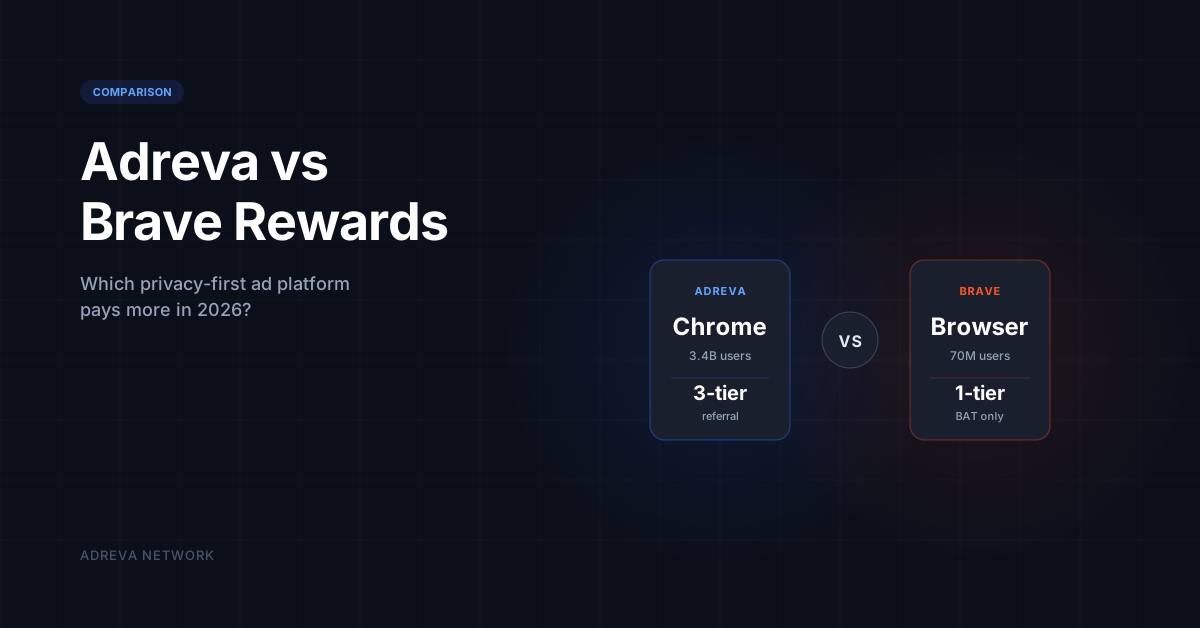
Adreva and Brave Rewards are the two best-known privacy-first advertising platforms in 2026, but they take structurally different approaches to the same problem. Brave Rewards is baked into the Brave browser and pays users in BAT (Basic Attention Token) for viewing notification ads. Adreva is a Chrome extension that runs inside any Chromium browser and pays users in their choice of major crypto tokens. Both protect user privacy, both pay real money, and both operate on the thesis that users deserve a share of the ad revenue their attention creates. The practical differences come down to reach, ad format, payout flexibility, and referral economics — and they matter for choosing the right fit. Here is how the two compare.
What Is the Core Architectural Difference?
Brave Rewards is a browser-native feature. You must use Brave Browser to participate — it is not available in Chrome, Firefox, or Safari. Ads appear as system notifications (and on Brave's New Tab page), and all reward accounting happens inside the browser.
Adreva is a Chrome extension. It installs on top of whatever Chromium browser you already use — Chrome, Edge, Brave itself, Arc, Opera — without switching browsers. Ads appear as in-page contextual placements that match on-device to the content being viewed. No browser switch required.
The practical implication: Brave requires a commitment to a specific browser. Adreva works wherever you already are.
Reach: Who Has the Bigger User Base?
Chrome dominates browser market share in 2026 with approximately 65% of global users (~3.4 billion). Brave browser reached 70 million monthly active users in 2024-2025 — significant for an independent browser but small compared to Chrome's base. Because Adreva runs on any Chromium browser (including Brave), its potential reach is the full Chromium ecosystem — approximately 3.4 billion users globally.
Reach matters for two reasons. First, advertisers prefer platforms with larger audiences, which raises per-impression rates. Second, referral programs compound faster in larger user populations. This is a structural advantage for Adreva's distribution model.
Ad Format Comparison
| Feature | Adreva | Brave Rewards |
|---|---|---|
| Where ads appear | In-page contextual placements on participating sites | System notifications and New Tab pages |
| Ad format | Display and native placements | Push-notification style |
| Frequency cap | Contextual — as user browses participating sites | User-configurable: 1-10 per hour |
| User control | Adjustable in extension settings | Adjustable in browser settings |
| Can advertisers reach a specific audience? | Context only — no personal targeting | Context + device-level behavioral signals |
Brave's notification format is less intrusive for users who actively browse but can feel spammy for users who leave their browser open. Adreva's in-page format surfaces naturally during normal browsing and disappears when the user isn't active.
Payout Comparison: What Do You Actually Get?
Brave pays exclusively in BAT (Basic Attention Token) — a native token launched in 2017 on Ethereum. BAT has a market cap in the hundreds of millions and can be sold on most major exchanges (Coinbase, Kraken, Binance). Users are paid monthly via Brave's internal wallet.
Adreva pays in points redeemable for multiple tokens, including USDC, SOL, and ETH, depending on the user's preference at redemption time. This spreads token-price risk and lets users choose tokens they already hold.
Typical earnings for moderate users on each platform, based on 2025-2026 benchmarks:
| User activity | Adreva (monthly) | Brave Rewards (monthly) |
|---|---|---|
| Light (30 min/day) | $2 – $6 | $1 – $4 |
| Moderate (2 hr/day) | $8 – $18 | $5 – $12 |
| Heavy (5+ hr/day) | $22 – $45+ | $10 – $20 |
Adreva's higher rates reflect two factors: in-page placements earn higher CPMs than notification ads, and Adreva's leaner stack returns more of the advertiser's spend to the user.
Referral Economics: Which Has a Better Program?
Brave Rewards does not operate a tiered referral program. Users earn purely from their own ad views. Adreva runs a 3-tier referral program paying 20% from direct referrals, 10% from second-tier, and 5% from third-tier — perpetually, for as long as both accounts stay active. This is the largest economic gap between the two platforms.
For a user with 10 active direct referrals, Adreva's program can add $20-50/month on top of their direct ad earnings. Brave offers no equivalent. See how the Adreva referral program works for the full math.
Privacy Architecture: How Do They Compare?
Both platforms are meaningfully more private than mainstream ad platforms, but with different architectures. Brave Rewards matches ads using device-level signals — data that never leaves the browser but can include some behavioral context. Adreva uses pure on-device contextual matching — only the publicly visible context of the current page is used, with no behavioral profile building even locally.
For users with the strongest privacy requirements, Adreva's context-only approach is marginally more conservative. For most users, both models are dramatically better than traditional ad tech. See Privacy by Design vs Privacy by Policy for the underlying framework.
Publisher Economics: Who Wins on Site Participation?
Brave pays publishers through the Brave Creators program — publishers register, users tip them with BAT, and Brave optionally matches revenue from its own ad network. Adreva pays publishers through direct revenue share on in-page placements on participating sites. Publishers receive a share of the advertiser spend when Adreva ads render on their inventory.
The models suit different site types. Brave Creators works best for individual creators (YouTube channels, Twitter accounts, personal websites). Adreva works best for publisher sites with traditional ad inventory.
Which Platform Should You Choose?
The answer depends on your primary goal:
- Choose Adreva if you want to keep using Chrome (or your current browser), you value payout flexibility across crypto tokens, and you plan to build a referral network over time.
- Choose Brave Rewards if you're already a Brave browser user or planning to switch, you prefer notification-style ads, and you want the single-token simplicity of BAT.
- Or use both: The two platforms are not mutually exclusive. Many power users run Adreva inside Brave browser to capture both streams simultaneously.
Frequently Asked Questions
Can I use Adreva and Brave Rewards at the same time?
Yes. Brave Rewards runs inside the Brave browser; Adreva runs as an extension. Installing the Adreva extension on Brave Browser captures both earning streams simultaneously. Earnings are independent and accrue in separate wallets.
Which platform has stronger privacy protections?
Both are meaningfully more private than mainstream ad platforms. Adreva's pure contextual matching is slightly more conservative than Brave's device-level behavioral matching, but the practical privacy gap is small compared to either one's advantage over traditional advertising networks.
Does Adreva work in Firefox or Safari?
Not currently. Adreva supports Chromium-based browsers (Chrome, Edge, Brave, Arc, Opera). Firefox and Safari versions are on the 2026 roadmap. Brave Rewards is exclusive to the Brave browser across all platforms.
Are BAT and Adreva's tokens interchangeable?
No. BAT is a specific Ethereum-based token. Adreva points are redeemable for the user's choice of supported tokens at payout time, including stablecoins like USDC. Users who want BAT specifically should use Brave; users who want payout flexibility should use Adreva.
What happens to my earnings if I uninstall the extension or browser?
Earnings remain in your platform account indefinitely on both services. Adreva points stay in your account; BAT stays in the Brave Rewards wallet. Both platforms support re-install without loss of balance.