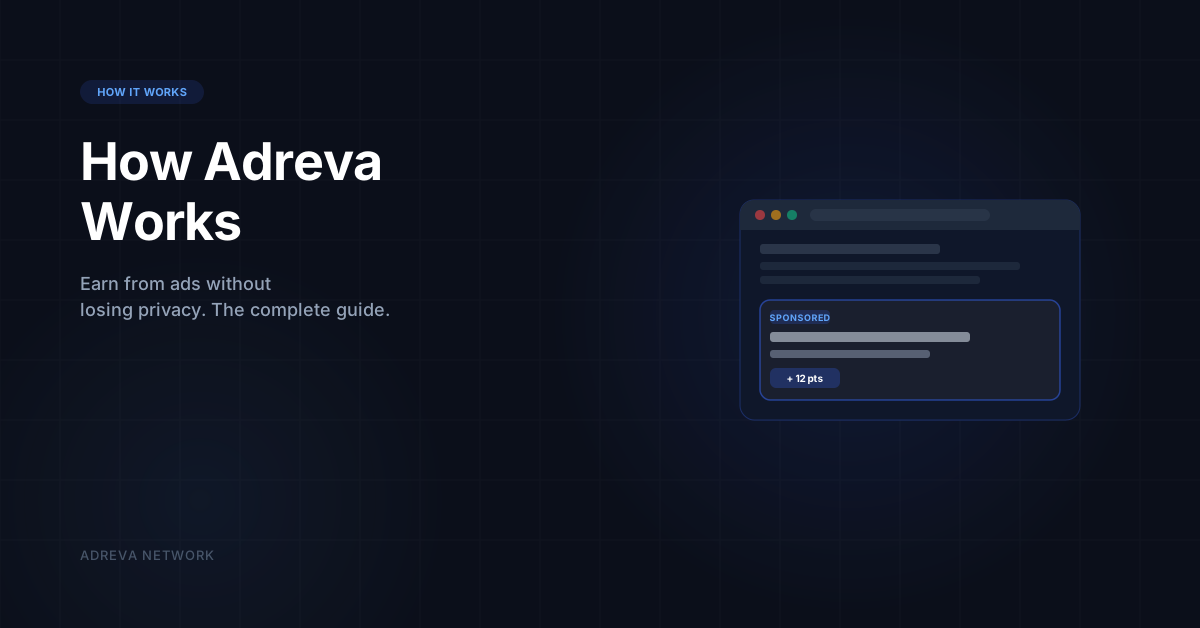
Adreva is a privacy-first Chrome extension that pays users for the attention they give to ads, using an on-device matching architecture so that no personal browsing data ever leaves the user's browser. When a user installs the Adreva extension, ads are selected and rendered locally based on the current page context, the user views non-intrusive placements, and the platform rewards that attention with points redeemable for cryptocurrency. Advertisers reach engaged audiences without third-party cookies, behavioral tracking, or user profiling. With 912 million people worldwide now using ad blockers and 79% of Americans concerned about data collection, Adreva represents a structurally different answer to the broken ad economy: users earn, advertisers reach real attention, and privacy is architectural — not a policy promise.
What Is Adreva in One Sentence?
Adreva is a Chrome extension that pays users points (redeemable for crypto) for viewing privacy-safe ads, with ad selection running entirely on the user's device so no personal data is ever transmitted to Adreva's servers.
How Does the Adreva Extension Actually Work?
Adreva works through four coordinated components running inside the user's browser.
1. The extension installs from the Chrome Web Store. Users go to the Adreva listing, click "Add to Chrome," and the extension loads. Installation takes under 60 seconds and requires no personal information beyond the email used to log in.
2. On-device ad matching selects relevant ads locally. When a user visits a webpage, the extension examines the page's public context (the topic, the site category, keywords visible on the page) inside the browser. It then selects ads from a pool of advertiser creative that has been downloaded to the user's device. At no point is browsing data sent to a server for targeting. For a deeper dive, see our guide on how on-device ad matching works.
3. Ad placements render in compatible slots. Adreva placements appear in designated zones on participating sites, replacing or augmenting existing ad inventory. Placements are non-intrusive — no pop-ups, no full-page takeovers, no autoplay video — and are always clearly labeled.
4. Attention is verified and rewarded. When a user views an ad, the extension logs the view locally and periodically submits a cryptographically-signed attestation of aggregate earnings to Adreva's rewards service. Points accrue in the user's wallet and can be redeemed for supported tokens.
What Does a User Actually Earn?
Earnings depend on location, browsing activity, and market ad demand. Based on 2025 platform data:
| User activity level | Typical monthly points | Approximate USD value* |
|---|---|---|
| Light (30 min/day browsing) | 1,500 – 3,500 | $2 – $6 |
| Moderate (2 hr/day browsing) | 6,000 – 12,000 | $8 – $18 |
| Heavy (5+ hr/day browsing) | 15,000 – 30,000+ | $22 – $45+ |
*USD equivalent varies by redemption token and market conditions. Earnings are additive to the Adreva referral program, which can 2-3x active users' total income.
How Does Adreva Stay Private by Design?
Privacy at Adreva is architectural rather than policy-based. Three structural choices make it so.
No cross-site tracking cookies. Adreva does not set third-party cookies and does not read third-party cookies from other ad networks. Every matching decision is made locally.
No user profile on Adreva's servers. Adreva does not store browsing history, site visit logs, or interest categories per-user. The only user data Adreva stores is the account identifier, the accrued points balance, and the payment/referral ledger.
Public data, public decisions. Any data used for ad matching is data visible on the public webpage itself — the article title, the topic category, visible page text. Private data (form inputs, email content, logged-in account info) is never read.
For the deeper architectural argument, see Privacy by Design vs Privacy by Policy.
How Does Adreva Compare to Other Reward Extensions?
| Feature | Adreva | Traditional Reward Extensions |
|---|---|---|
| Data collection | None — on-device matching | Extensive — cross-site tracking + data resale |
| Payout model | Crypto via on-chain redemption | Cash / gift cards / crypto (varies) |
| Ad format | Contextual, non-intrusive placements | Varies — often includes survey walls or popups |
| Referral structure | 3-tier: 20% / 10% / 5%, perpetual | Typically 1-tier, one-time bonus |
| Transparency | Open public ledger of earnings and ad campaigns | Typically closed / opaque |
How Does the Referral System Work?
Adreva's referral program is a perpetual 3-tier system. You earn 20% of direct referrals' ad earnings, 10% of second-tier referrals, and 5% of third-tier referrals — for as long as all accounts remain active. Unlike one-time affiliate bonuses, these rewards compound over time as the network grows. For full details, see our complete guide to how the Adreva referral program works.
What Makes Adreva Different From Brave Rewards?
Brave Rewards is the best-known incumbent in user-paid advertising and Adreva shares its broad philosophy — pay users for attention, protect privacy. The practical differences come down to reach and monetization surface. Brave ads only run inside the Brave browser, which has ~70M monthly users. Adreva runs as a Chrome extension, letting any of Chrome's ~3.4B users participate without switching browsers. Adreva also pays in broader crypto assets and operates a richer referral economy than Brave's single-tier creator tips.
Who Should Use Adreva?
Adreva fits three user profiles best:
- Privacy-conscious internet users who want to be compensated for the attention they already give the web, without feeding surveillance infrastructure.
- Crypto-native users who want passive, no-commitment earnings payable in tokens they already use.
- Web3 community builders who can multiply income through the perpetual 3-tier referral program.
How Do Advertisers Use Adreva?
Advertisers buy reach on Adreva through the Adreva Advertiser Dashboard — a self-serve platform that lets brands launch campaigns, upload creative, set targeting rules (which operate on contextual, not personal, signals), and fund campaigns. Performance reporting is fully transparent and available in real time. Unlike traditional platforms, advertisers cannot target individuals — only contexts — which both satisfies GDPR/CCPA requirements and restores brand safety around user attention.
How Does Adreva Handle Compliance?
Adreva's architecture is designed to exceed the requirements of major privacy regulations by default:
- GDPR: No personal data is processed without explicit user participation in the reward program, and all identifiers are minimized.
- CCPA / CPRA: No sale or share of personal information because no personal browsing data is collected.
- EU DMA / DSA: Transparent ad disclosure on every placement.
For a broader picture of the regulatory environment, see GDPR, CCPA, and Beyond.
Frequently Asked Questions
Is Adreva free to use?
Yes. The Adreva Chrome extension is free to install and use. Users earn points for viewing ads; there are no subscription fees, no paywalls, and no hidden costs.
How do I install Adreva?
Visit the Adreva listing on the Chrome Web Store, click "Add to Chrome," sign in with an email to create an account, and begin browsing. The first points typically accrue within the first hour of active browsing.
Does Adreva work in browsers other than Chrome?
Adreva supports all Chromium-based browsers (Chrome, Edge, Brave, Arc, Opera) because they share the Chrome extension runtime. Firefox and Safari support are on the public roadmap.
How does Adreva make money if users are getting paid?
Adreva earns a margin between the advertiser's ad spend and the user payout. Because Adreva eliminates the large intermediary layer of the traditional ad tech supply chain — where only 51 cents of every advertiser dollar reaches publishers — it can both pay users and sustain the platform at far lower takes than incumbents.
Can I use Adreva on mobile?
The current Adreva extension is desktop-only because Chrome's extension runtime does not fully support mobile. A native mobile app is on the roadmap for 2026.
How long does it take to earn enough to withdraw?
Withdrawals are available once a minimum point threshold is reached (currently 10,000 points). Typical active users reach this in 2-4 weeks; heavy users can reach it weekly.