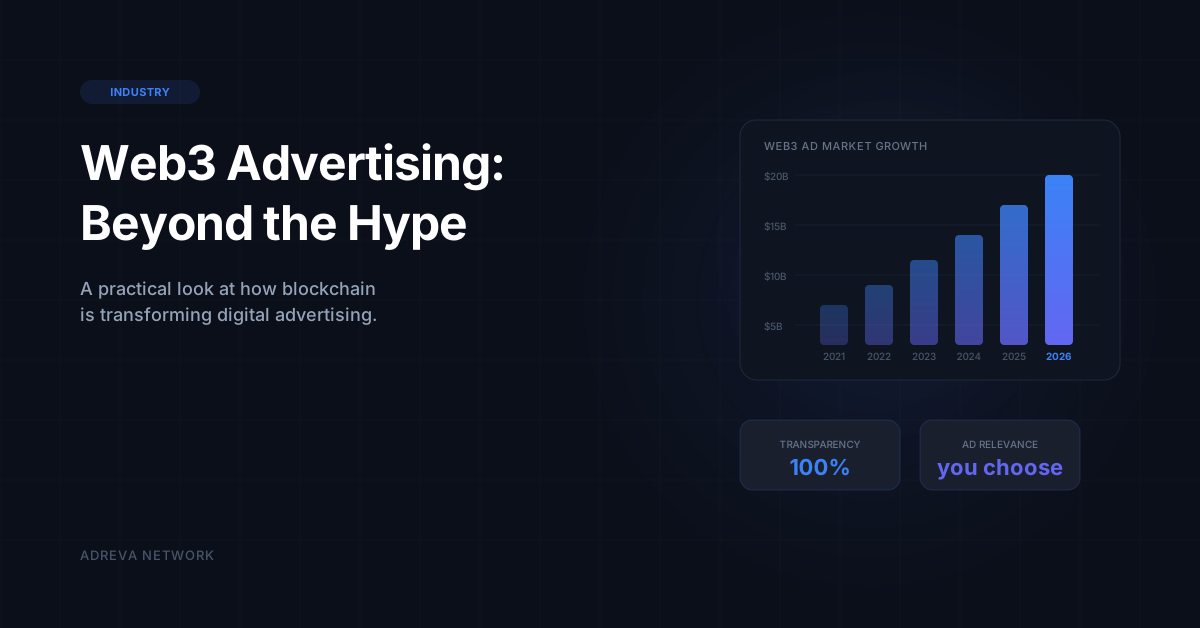
Let's be honest: Web3 advertising has a credibility problem. Over the past five years, dozens of projects have promised to "revolutionize" digital advertising with blockchain. Most launched tokens, attracted speculators, and quietly faded away without ever serving a single real ad to a real user.
The skepticism is earned. But the underlying thesis—that blockchain can fix structural problems in advertising—is still sound. The question isn't whether Web3 can improve advertising. It's whether anyone will build it right.
What Failed (And Why)
Most Web3 ad projects made the same mistake: they tried to put the entire ad serving pipeline on-chain. Every impression, every bid, every targeting decision—all on a blockchain. This is technically impractical and economically nonsensical. You don't need decentralized consensus to decide which banner ad to show a user.
Others focused on token speculation rather than product-market fit. They launched governance tokens with no product, attracted traders with no interest in advertising, and collapsed when the inevitable token price decline drove away the only "users" they had.
The pattern is clear: technology in search of a problem, rather than a problem in search of the right technology.
What Actually Needs Decentralization
Not everything in advertising needs to be on-chain. But some things desperately do:
- Payment settlement. Advertisers should be able to verify exactly where their money went. On-chain payments provide this transparency.
- Engagement verification. Did a real human actually see this ad? Cryptographic attestation from on-device verification is far more reliable than self-reported metrics from ad servers.
- Reward distribution. Users who contribute attention should receive verifiable, transparent compensation—not vague promises from opaque intermediaries.
Everything else—ad creative rendering, targeting logic, content delivery—can and should remain off-chain for performance and practicality.
The Hybrid Architecture
This is the approach Adreva takes. We call it "verify on-chain, serve off-chain." The browser extension handles ad delivery and rendering locally, with the speed and efficiency of any traditional ad server. But the verification layer—proving that real engagement happened and triggering payment—uses cryptographic proofs.
This hybrid model gives you the best of both worlds: the user experience of a Web2 product with the transparency guarantees of Web3 infrastructure.
Real Metrics, Real Advertisers
The test of any advertising platform isn't its whitepaper—it's whether real advertisers spend real money and get real results. Adreva's early campaigns have demonstrated:
- View-through rates 4x higher than traditional display
- Zero detected bot traffic (compared to industry averages of 15-30%)
- 100% budget transparency—advertisers see every cent on their dashboard
These aren't theoretical improvements. They're the direct result of eliminating intermediaries and aligning incentives between advertisers and users.
The Quiet Revolution
The future of Web3 advertising won't arrive with a bang. There will be no overnight disruption of Google's ad empire. Instead, it will be a gradual shift: advertisers discovering that verified, consent-based channels deliver better ROI. Users discovering that they can earn from the attention they're already giving away. And the industry slowly recognizing that the old model—built on surveillance, opacity, and fraud—was never sustainable to begin with.
Web3 advertising isn't hype. It just needed to grow up. And it's finally starting to.